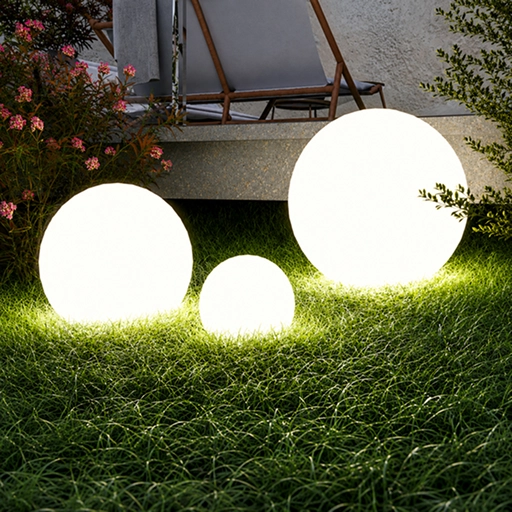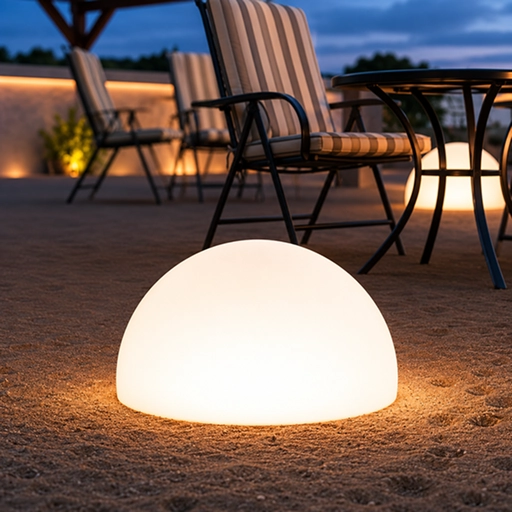
It’s a setting that tends to get treated as a threshold rather than a space — somewhere people pass through rather than experience. The brief here, even if unspoken, is one that comes up constantly in commercial architecture: how do you make an arrival feel special?
The answer was the Globo E26.
Spherical forms are disarming. They don’t have a front or a back, they don’t impose direction, and they hold light in a way that’s hard to replicate with conventional fixtures. Against the hard geometry of an office façade — glass, stone, straight lines — a luminous sphere reads as a deliberate counterpoint.
In Bucharest, the Globo was placed at the building entrance where it does two things at once: it marks the space and softens it. During the day, the matte or glossy polyethylene surface holds up as a sculptural object. At night, it earns its keep as a light source — diffusing evenly, without hotspots, without glare.
For specifiers and architects considering the Globo for similar applications, a few things stand out:
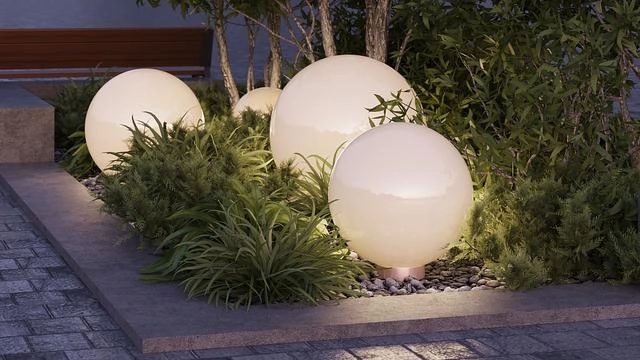
Entrance lighting is often the last thing specified and the first thing noticed. The Globo E26 makes a case for treating it differently — as a design element that earns its place in daylight and delivers at night. Simple geometry, solid materials, real-world durability.
Sometimes the right fixture is just a sphere of light. Done well, that’s enough.